
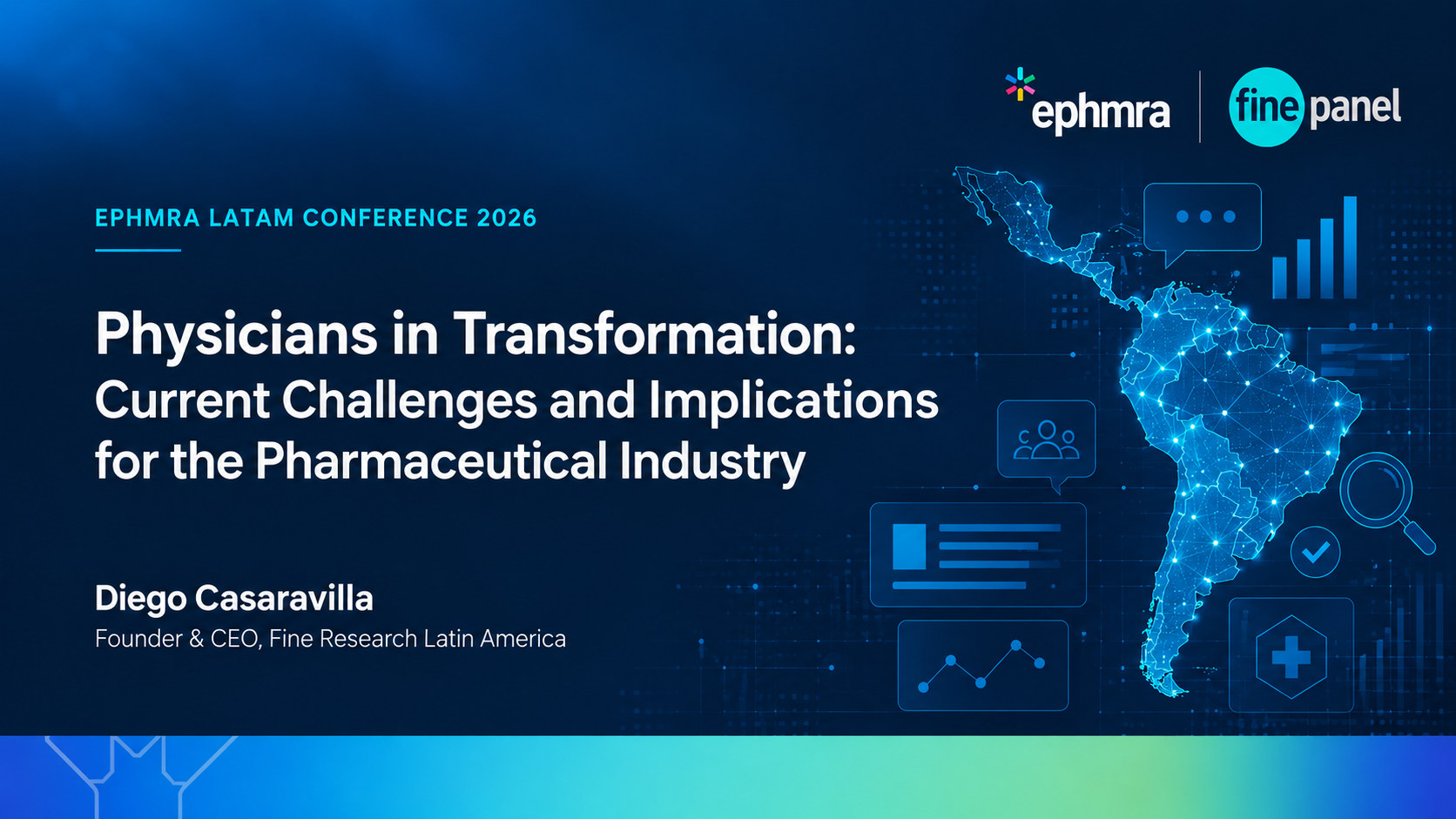
Fine Research Shares New Insights on the Transformation of Brazilian Physicians at the EPHMRA LATAM Conference 2026
New proprietary research reveals how growing competition, professional undervaluation, and increasingly empowered patients are reshaping the medical profession—and what this means for pharmaceutical engagement in Latin America.
On October 22, 2026, Fine Research Latin America participated in the EPHMRA LATAM Chapter Meeting, bringing fresh, data-driven insights into the evolving healthcare landscape in Brazil.
The event brought together healthcare market research professionals and industry experts to discuss some of the most important challenges and opportunities facing the pharmaceutical sector across Latin America.
Representing Fine Research, Diego Casaravilla, Founder & CEO, presented “A New Physician Requires a New Relationship: How the Transformation of Brazilian Physicians is Reshaping Pharma Engagement Strategies.”
Drawing on proprietary research conducted through Fine Panel, Latin America’s leading healthcare professional research panel, the presentation explored how the medical profession has changed over the past decade and why pharmaceutical companies need to rethink the way they engage with physicians.
A Decade of Transformation: What the Data Reveals
By comparing findings from studies conducted in 2016 and 2026, Fine Research identified important changes in physicians’ professional experiences, perceptions, and relationships with patients.
The research highlights several significant trends.
1. Physicians Continue to Feel Undervalued
Despite considerable changes in Brazil’s healthcare environment, professional recognition remains a major concern.
In 2016, 40% of Brazilian physicians selected “undervalued” as the adjective that best described their profession. Ten years later, that figure remains remarkably high at 31%.
Meanwhile, the proportion identifying their profession as overworked or under pressure increased from 22% to 25%, and those selecting “underpaid” rose from 10% to 12%.
These findings reflect persistent challenges related to professional recognition, workload, and economic pressures.
Physicians’ own explanations point to three recurring issues: the rapid expansion of medical education and growing competition, financial dependency on healthcare payers, and a perceived erosion of professional authority.
2. The Brazilian Medical Workforce Is Changing Rapidly
The transformation goes well beyond professional sentiment.
According to data from Brazil’s Federal Council of Medicine presented during the session, the number of physicians increased from approximately 131,000 in 1990 to 576,000 in 2024—a rise of 339%, far exceeding population growth over the same period.
The profession is also becoming younger and more diverse.
Women now represent approximately 50% of Brazilian physicians, rising to 58% among those under 39.
These demographic changes have significant implications for how pharmaceutical companies segment audiences, design communications, and develop long-term relationships with healthcare professionals.
3. The Rise of the Empowered Patient Is Redefining Medical Authority
One of the most striking findings concerns the changing physician-patient relationship.
Physicians report that, compared with ten years ago:
- 86% say patients are more likely to arrive at consultations with their own ideas.
- 80% say patients increasingly expect to participate in treatment decisions.
- 77% report that patients require more evidence before accepting medical recommendations.
- 66% say patients are more likely to question their diagnoses or clinical recommendations.
Patients are also bringing new sources of information into the consultation room.
According to the research, physicians report patients referring to:
- 54%: Google and online searches
- 51%: Social media
- 51%: Artificial intelligence tools, including ChatGPT
- 28%: Health influencers
This creates a new dynamic in which physicians must navigate not only growing professional competition but also an increasingly informed—and sometimes misinformed—patient population.
Notably, 42% of physicians identified misinformation and social media influence as a professional challenge.
What Does This Mean for the Pharmaceutical Industry?
The central message of Fine Research’s presentation was clear:
A new physician requires a new relationship.
Traditional approaches to pharmaceutical engagement need to evolve alongside the profession itself.
The findings point to three important opportunities for the industry:
Become a scientific and educational partner. Physicians need access to reliable, relevant, and continuously updated scientific information to support clinical decisions and address patient questions.
Recognize the changing medical workforce. Communication strategies should reflect a younger, increasingly female, and more digitally engaged physician population, with greater personalization and representation.
Support physicians beyond product promotion. Educational initiatives, research collaboration, and programs that recognize the value of medical practice can help build more meaningful and sustainable relationships.
The research suggests that effective HCP engagement increasingly depends on understanding physicians not only as healthcare decision-makers, but also as professionals navigating significant structural and social changes.
Bringing Together Healthcare Research Expertise Across Latin America
The ePHMRA LATAM Chapter Meeting featured contributions from leading organizations across the healthcare insights industry.
The conference opened with Ana Maria Aguirre Arteta, Senior Director, Global POP Governance – Global Medical Affairs at Novartis.
Other sessions included:
- Jessica Cesca and Mauro Morando, from Peas in the Pod, discussing the Type 2 Diabetes landscape in Argentina, with Diego Casaravilla, Fine Research, CEO, serving as session convenor.
- Daniela Anselmi, Director at Inizio Ignite, Research Partnership, presenting evidence gaps across Brazil’s healthcare journey, with Silvina Suárez, Head of Service Line at Ipsos, as convenor.
- Paul Reed and Esperanza Avila, from Inizio Ignite, Research Partnership, discussing real-world evidence generation in Latin America.
The event provided an important forum for exchanging perspectives on the changing healthcare landscape and the growing role of evidence-based insights in pharmaceutical decision-making.
Fine Research: Turning Local Healthcare Data into Actionable Insights
Fine Research’s participation reflects its long-standing commitment to advancing healthcare market research across Latin America.
With more than 25 years of experience in the region, Fine Research has developed extensive expertise in healthcare data collection, physician engagement, and multi-country research.
Through Fine Panel, a pioneering regional healthcare professional panel, the company provides access to medical professionals across Latin America, supporting pharmaceutical companies, research agencies, and global insights teams with reliable primary data.
Beyond delivering high-quality fieldwork, Fine Research continuously invests in understanding the healthcare professionals who participate in its research.
This combination of regional reach, direct physician relationships, local market expertise, and proprietary research enables Fine Research to contribute valuable perspectives on the forces shaping healthcare across Latin America.
The findings presented at ePHMRA illustrate the importance of this approach: meaningful insights depend not only on reaching the right respondents, but also on understanding the professional and social context in which they operate.
As the healthcare landscape continues to evolve, Fine Research remains committed to connecting the global healthcare insights community with the voices of Latin American physicians.
To learn more about Fine Research’s healthcare data collection capabilities and Fine Panel’s coverage across Latin America, visit fine-research.com and finepanel.net.
Research note: The physician sentiment comparison draws on Fine Panel surveys conducted in Brazil in 2016 (n=1,040) and 2026 (n=361). Other findings are drawn from the research and sources presented during the EphMRA session. Results reflect the respective survey questions and respondent bases.